The VIVO Dual Vertically Stacked Ultrawide Monitor Desk Mount review is for buyers who want two exceptionally large displays arranged vertically while keeping the desktop clear.
Its high capacity and broad positioning options are appealing, but desk thickness, VESA pattern, and screen weight need careful checking before purchase.
VIVO Dual Ultrawide Mount Review Summary
The quick verdict
2,000+ ratings
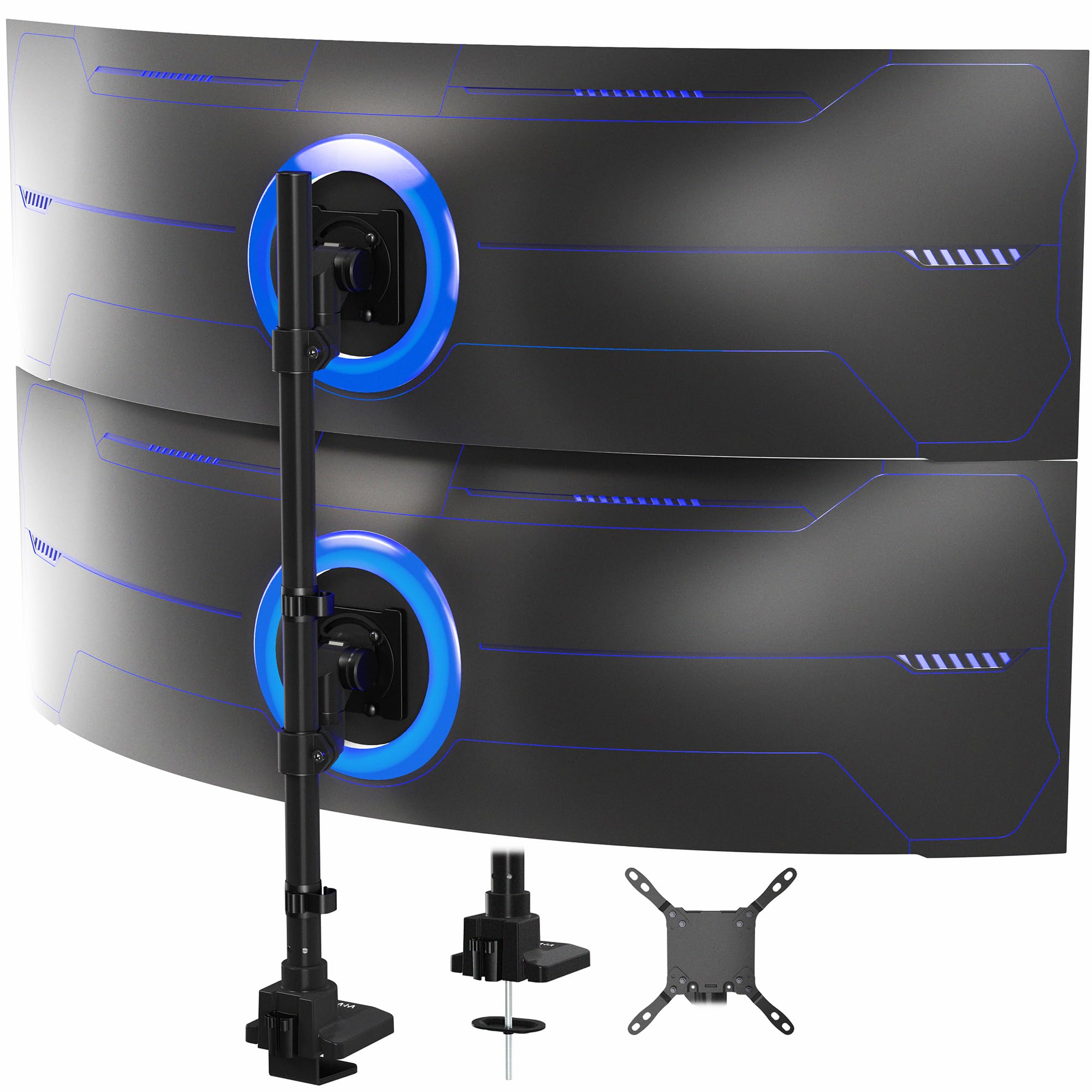
Read Amazon ReviewsVIVO STAND-V257R Dual Ultrawide Monitor Mount
A desk-clamped vertical mount for people building a two-screen setup with large ultrawide monitors or compatible TVs.
- Supports two ultrawide screens up to 57 inches; compatible TVs can be up to 43 inches.
- Maximum weight is up to 48.4 pounds per curved screen or 59.4 pounds per flat screen.
- The lower arm tilts from +55 to -35 degrees, swivels 132 degrees, and rotates 180 degrees; the upper arm swivels and rotates 360 degrees.
- Screen height can be adjusted along the center pole.

Pros
- Accommodates two very large ultrawide screens in a vertical layout.
- Provides substantial stated weight capacity, with separate limits for curved and flat displays.
Consider before buying
- The vertical arrangement is specialized and will not suit buyers who want their two displays side by side.
- Desk thickness must be within the mount’s relatively specific clamp or grommet limits.
Read the full review summary
The STAND-V257R is designed for a specific setup: two vertically stacked ultrawide screens, each up to 57 inches, or compatible TVs up to 43 inches.
Its stated capacity differs by screen type: up to 48.4 pounds per curved screen or 59.4 pounds per flat screen. That makes the weight and shape of each display central to fit, rather than screen size alone.
Height adjustment along the center pole, several tilt and rotation options, cable clips, and a choice of clamp or grommet mounting give the stand flexibility for a fixed workstation.
It is most relevant to people committed to a vertical two-display layout and whose desk and VESA mounting points match the limits. A more conventional side-by-side or single-screen setup may not use its specialized design.
The buying factors
VIVO Dual Ultrawide Mount Scorecard
Editorial scores reflect listed features and buyer fit; they are not laboratory measurements or customer ratings.
Large-screen fit
Supports two ultrawide screens up to 57 inches, with different maximum weight limits for curved and flat displays.
Positioning range
Includes tilt, swivel, rotation, and height adjustment, with distinct movement ranges for the upper and lower arms.
Mounting flexibility
Offers a heavy-duty C-clamp or optional grommet mount, though each has a specific desk-thickness limit.
VESA compatibility
Supports five listed hole patterns, including sizes beyond the common 75-by-75 and 100-by-100 mm formats.
Cable organization
Clips on the center pole provide a straightforward route for organizing power and AV cords.
Setup specificity
Its vertical arrangement and heavy-screen limits suit a narrower range of workstations than a general dual-monitor arm.
Key Features and Specifications of VIVO Dual Ultrawide Mount
- Supports two ultrawide screens up to 57 inches; compatible TVs can be up to 43 inches.
- Maximum weight is up to 48.4 pounds per curved screen or 59.4 pounds per flat screen.
- The lower arm tilts from +55 to -35 degrees, swivels 132 degrees, and rotates 180 degrees; the upper arm swivels and rotates 360 degrees.
- Screen height can be adjusted along the center pole.
- Mounts with a C-clamp on surfaces up to 1.45 inches thick or with an optional grommet mount on surfaces up to 1.26 inches thick.
- Cable clips on the center pole help organize power and AV cords.
- Detachable VESA plates support 75-by-75, 100-by-100, 200-by-100, 100-by-200, and 200-by-200 mm patterns.
Pros and Cons of VIVO Dual Ultrawide Mount
Pros
- Accommodates two very large ultrawide screens in a vertical layout.
- Provides substantial stated weight capacity, with separate limits for curved and flat displays.
- Offers multiple positioning adjustments and height changes along the pole.
- Includes both clamp and optional grommet mounting approaches.
- Detachable plates and broad VESA pattern support can simplify matching the stand to compatible screens.
Consider before buying
- The vertical arrangement is specialized and will not suit buyers who want their two displays side by side.
- Desk thickness must be within the mount’s relatively specific clamp or grommet limits.
- Curved-screen capacity is lower than flat-screen capacity, so buyers need to check each display’s weight and type.
- Large-screen fit still depends on matching VESA holes and the available mounting space.
Who Should Buy VIVO Dual Ultrawide Mount?
Good fit
Consider the STAND-V257R if your workstation is planned around two vertically stacked ultrawides and you have already checked both screens’ weights, screen type, and VESA hole patterns.
The broad upper-arm rotation and adjustable lower arm offer options for orienting the screens, while height adjustment along the pole helps position the stack for your desk.
It is also worth considering when you want to reclaim desktop space and can attach a mount to the back of the desk or through a suitable grommet opening.
Before choosing a mounting method, measure the desk or mounting surface at the attachment point and confirm it falls within the stated thickness limit.
Treat this as a layout-specific purchase rather than a general-purpose stand.
Its strongest case is a pair of large compatible displays, with weight comfortably within the relevant per-screen limit and a vertical arrangement that makes sense for your work.
Who should skip it
Skip this design if you need the screens arranged side by side, want a freestanding base, or have a desk surface that cannot accommodate either specified mounting method.
Look elsewhere if either screen exceeds the applicable weight limit or its VESA pattern does not match one of the listed sizes. Confirm those details for both displays before buying.
How the VIVO Dual Ultrawide Mount Fits a Vertical Workstation
Large screens require a full compatibility check
The maximum screen diagonal is only one part of the fit. Each display also needs to stay within the weight limit for its screen type and offer a supported VESA pattern.
Check both monitors individually, especially when pairing curved and flat panels or displays of different sizes.
Vertical placement changes the desk layout
Stacking screens uses height to place two displays in one central column, which can suit a compact desk width.
The tradeoff is that the upper and lower positions are different, so consider which screen you use most and whether that arrangement works for your viewing habits before committing.
Movement differs between the two arms
The upper arm can swivel and rotate through 360 degrees, while the lower arm has a 132-degree swivel and 180-degree rotation range.
The lower arm also has a stated tilt range, and both displays can be adjusted in height along the center pole. These differences matter if you expect to reposition both screens frequently.
Mounting choice depends on the desk
The C-clamp accommodates surfaces up to 1.45 inches thick; the optional grommet mount has a lower thickness limit of 1.26 inches. Measure the attachment area and check the desk’s construction and underside clearance before settling on either method.
Alternatives to VIVO Dual Ultrawide Mount
Computer Monitor Arms alternative
2,000+ ratings
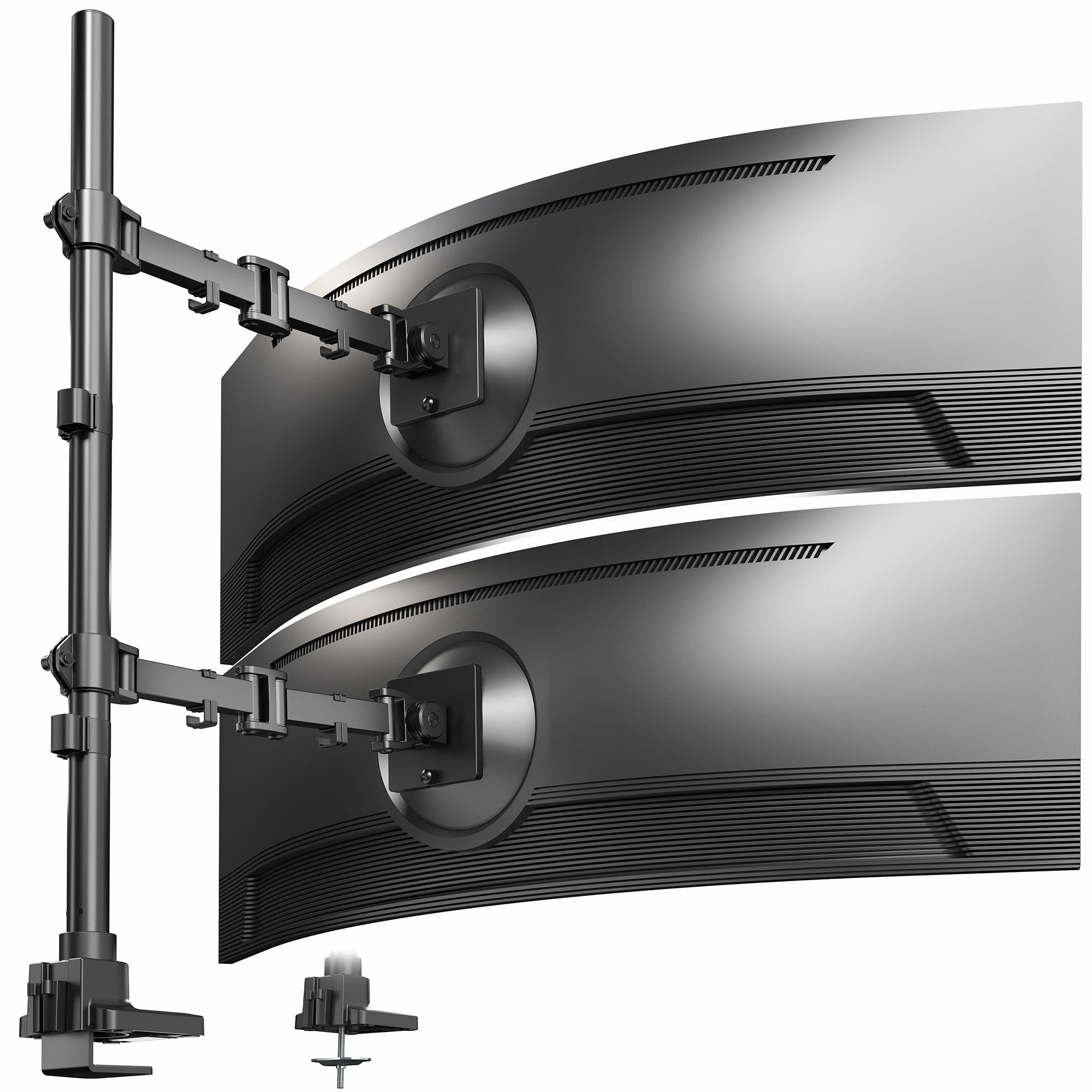
Read Amazon ReviewsVIVO Dual Ultrawide Monitor Extra Tall Desk Mount STAND-V120T
Choose the STAND-V257R when you need a vertical stack and your screens fit its larger size and weight limits.
The STAND-V120T is a relevant alternative for two smaller compatible ultrawides if its mounting limits fit your desk; confirm the intended screen layout before choosing.
- The STAND-V120T supports two ultrawides up to 49 inches and up to 44 pounds each, with a C-clamp for desks up to 1.7 inches thick or an optional grommet mount for surfaces up to 1.5 inches thick.
- The STAND-V257R holds two screens in a vertical stack, with support up to 57 inches and different capacity limits for curved and flat screens.
Computer Monitor Arms alternative
2,000+ ratings
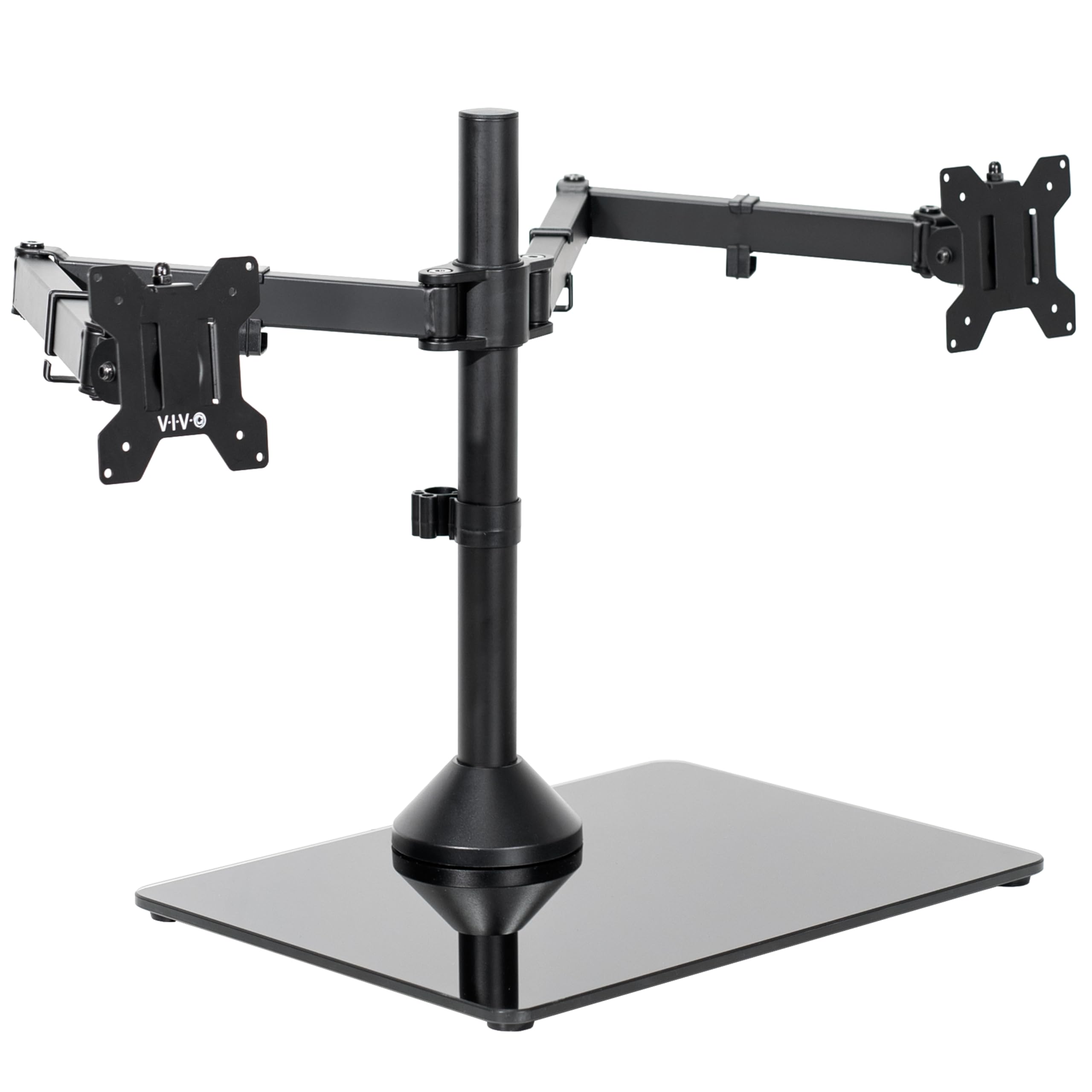
Read Amazon ReviewsVIVO Dual Ultrawide Monitor Desk Mount STAND-V038FG
Consider the STAND-V038FG if you want a freestanding base and your two displays are within its smaller size and weight limits.
The STAND-V257R better matches a desk-clamped vertical stack of much larger screens, provided the desk and displays meet its requirements.
- The STAND-V038FG is a freestanding mount for two ultrawides up to 38 inches and 22 pounds each.
- It uses a padded glass base measuring 17 by 12.8 inches, with articulated arms and center-pole height adjustment.
- The STAND-V257R is a vertically stacked mount with support for two ultrawides up to 57 inches and desk attachment by clamp or grommet.
Is VIVO Dual Ultrawide Mount Worth It?
The VIVO STAND-V257R is worth considering for a carefully planned vertical workstation with two compatible ultrawide screens.
Its standout appeal is the combination of very large supported screen size, substantial stated weight limits, adjustable positioning, and clamp or grommet mounting.
Buy only after checking the exact weight and VESA pattern of each display, along with the desk’s thickness at the attachment point.
If those fit and a vertical stack suits your routine, this mount offers a focused solution; otherwise, its specialized layout and mounting requirements make it a poor match.
Your review at a glance
2,000+ ratings
Read Amazon ReviewsVIVO STAND-V257R Dual Ultrawide Monitor Mount
A desk-clamped vertical mount for people building a two-screen setup with large ultrawide monitors or compatible TVs.
- Supports two ultrawide screens up to 57 inches; compatible TVs can be up to 43 inches.
- Maximum weight is up to 48.4 pounds per curved screen or 59.4 pounds per flat screen.
- The lower arm tilts from +55 to -35 degrees, swivels 132 degrees, and rotates 180 degrees; the upper arm swivels and rotates 360 degrees.
- Screen height can be adjusted along the center pole.